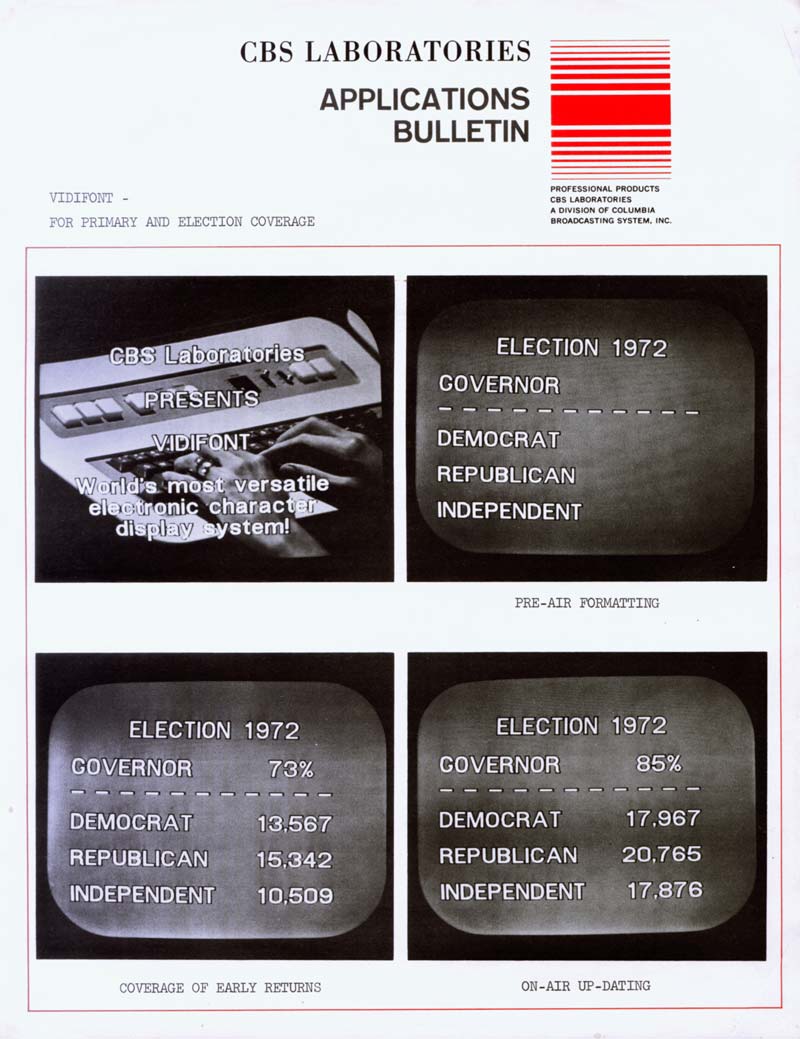
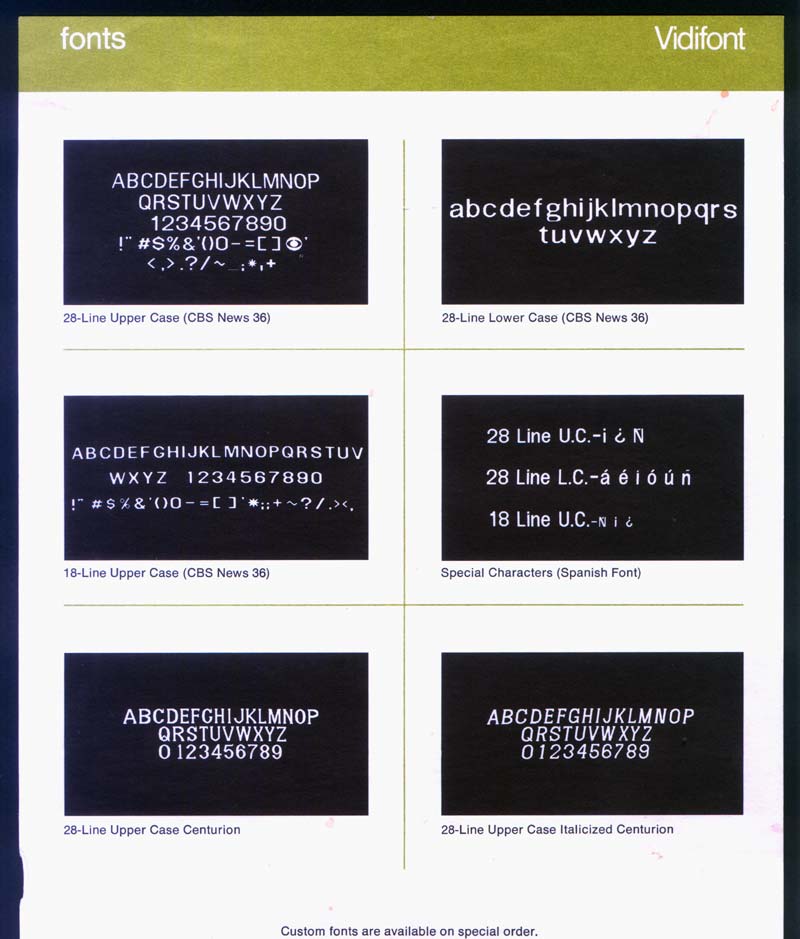
Take font.
And now, a brief homage to the Vidifont.
Let me pay my respects to the device that, for the first time, allowed proportionally-spaced, electronically-generated type to be drawn on the NTSC screen on demand.
Click on each of the images below to see at a larger size, and be sure to follow the links to a couple of other sites that give you a more complete picture of what the Vidifont was designed to do in a time when broadcast television was way more analog than digital.

No, I'm not ignoring the Chyron (or Chiron), but I have to take a moment here to share one of my prized chunks of early television nostalgia...a brochure for the device that first gave me hope that there was a way to display type on TV that didn't involve shooting it off off a black card with a camera.
The Vidifont. The original model, from CBS Labs, which became Thomson CSF Labs, which became, well, I've lost count. It's true that I did most of my work on the Vidifont IV (here's the actual unit I used at Atlanta's WTCG in the late 1970s), but my fascination with TV graphics began with this device.
Two hard-wired fonts, big and small, and by the way, the small one’s all caps.
Here's a fascinating first-hand report written by Stanley Baron, one of the principal designers of the system at CBS Labs, on how the Vidifont came to be.
He covers a couple of key design goals and how they were achieved: first of all, proportional fonts, where the width of an 'M' was wider than the width of an 'I.' (Mr. Baron holds a patent on the approach used, where "timing codes" corresponding to the width of characters told the machine where—or, more accurately, when—to begin drawing the next digital letter on the line.)
He also details the economic considerations involved, where CBS basically determined they were spending so much money creating 35mm slides for namesupers (the hardware costs for the specialized camera itself were considerable) that they could easily recoup that and more by developing the Vidifont. It's a classic story where other companies said it couldn't be done, and Mr. Baron said "well, I see a way."
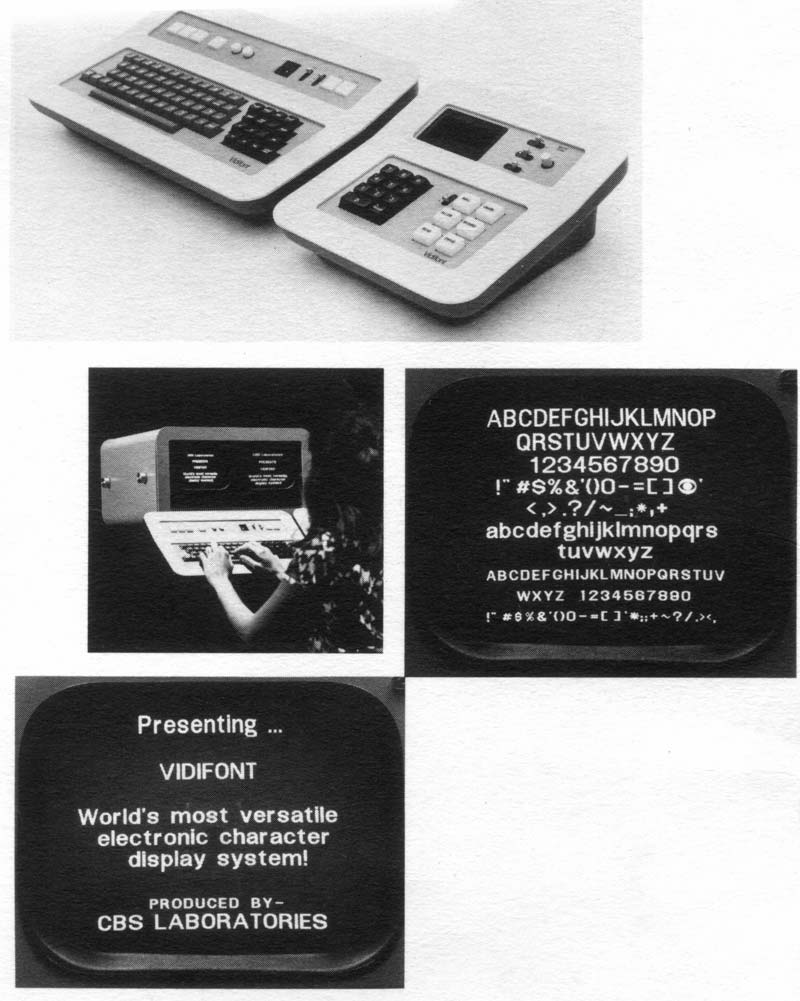
Here's an excerpt from one of the brochure's documents:
The Vidifont system is a television titling system designed to eliminate the need for artwork or menu-board titling by providing the user with electronically-generated, instantly-available, quality characters. A complete Vidifont system consists of a basic Vidifont package, a storage system and miscellaneous accessories or options.
In Vidifont systems, fonts are stored in semiconductor read-only-memories (ROMs), factory-installed in the Vidifont. A basic ROM system includes a 28 scan-line high set of upper-case characters of proportional widths (CBS News 36). There are 62 letters, numbers, punctuation marks, and symbols in the set. Other ROM fonts are available as options.
The system allows display of up to 16 lines — or rows — of characters with as many as 32 characters per row. because of proportionally-spaced characters, the actual number per line will vary.
The basic system features two speeds of roll and crawl, three speeds of flash, as well as four-position pushbutton tabs and centering. The capability to colorize (word by word) and edge is built in, and may be tied to the optional Colorizer Keyer.
The basic system consists of at least three units, the Display Control Unit, Power Supply, and Composer Keyboard. The Display Control Unit (DCU) is a rack-mounted unit containing all the logic and memory circuitry to produce the electronic characters.
Here's a scanned PDF of Rudi Bass's journal article in the 1971 edition of The Journal of Typographical Research on 'The Development of Vidifont,' which examines (more than the hardware itself) the inherent challenges of making type readble onscreen in the (about to be obselete) NTSC television system. (Thanks to Dana M. Lee, formerly of CITY-TV in Ontario.)